
If you’re getting ready to replace the floors in your Alpharetta home, you’ve almost certainly hit this question: LVP vs laminate flooring. Both look like hardwood, both cost less than hardwood, and both install with a click-lock system you can tackle over a weekend. But they are built differently, perform differently, and the wrong choice for your home can mean repairs or replacement far sooner than you planned.
At BEC Flooring, we’ve helped thousands of North Atlanta homeowners navigate exactly this decision. Here’s what actually matters when comparing luxury vinyl plank and laminate for a Georgia home.
LVP vs Laminate Flooring: What Each One Actually Is
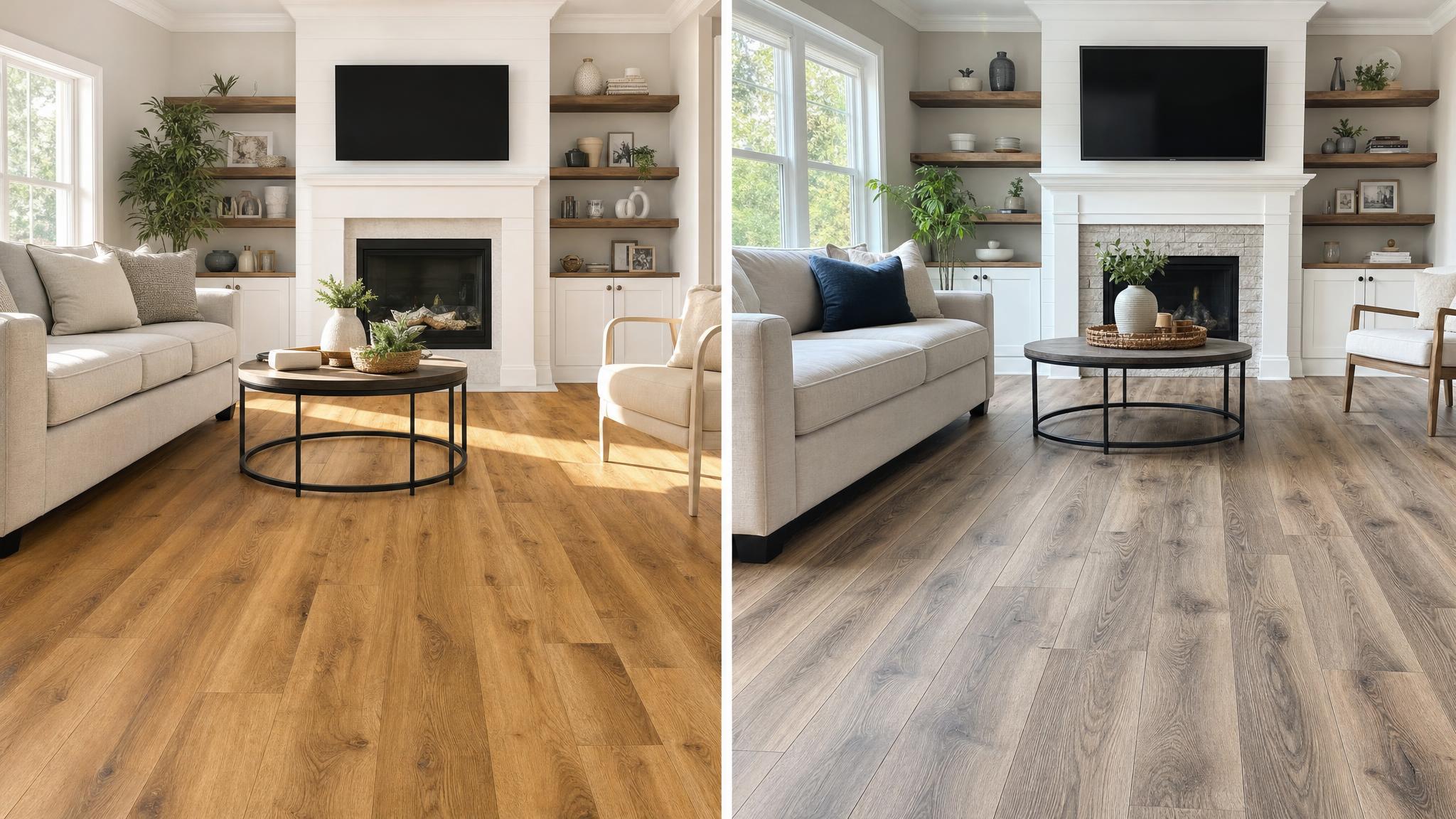
Luxury vinyl plank (LVP) is a 100% synthetic product. It’s built in layers: a rigid or semi-rigid core (often stone-plastic composite or wood-plastic composite), a photographic film that mimics wood grain, and a clear wear layer on top. The entire plank is waterproof by construction.
Laminate is built around a high-density fiberboard (HDF) core, which is compressed wood fiber. A printed decorative layer sits on top, then a hard melamine wear layer. The look can be stunning, but that wood-fiber core has a real weakness: it swells, warps, and buckles when it absorbs moisture.
That single structural difference drives most of the real-world performance gap between the two. Both product types are available in low-VOC certified versions; if indoor air quality is a concern, look for products certified under FloorScore or Greenguard, and check the EPA’s guidance on volatile organic compounds and indoor air quality before making your selection.
Water Resistance: The Deciding Factor for Georgia Homes
Georgia’s humidity is not gentle on flooring. Alpharetta summers bring prolonged heat and humidity that work their way into subfloors, and basements in North Atlanta are prone to moisture intrusion. This is where LVP wins decisively in the laminate vs vinyl plank flooring comparison.
LVP is genuinely waterproof. You can mop it, let your dog track in wet paws, or have a washing machine overflow, and the planks themselves will not be damaged. Water at seams can still reach the subfloor if it pools for extended periods, but the planks hold their shape.
Laminate is water-resistant at best. Most modern laminate handles quick spills fine, but prolonged moisture exposure causes the HDF core to swell. Once a laminate plank swells, it does not recover. You’re replacing boards, or in serious cases, the entire floor.
If you’re installing in a kitchen, bathroom, mudroom, or any room that sees humidity swings, LVP is the safer call for Georgia living.
Durability and Lifespan: LVP vs Laminate Flooring Head to Head
Both products are durable daily-use floors, but their durability plays out differently depending on what you’re throwing at them.
Laminate has excellent scratch resistance. Its hard melamine surface holds up well against pet claws, chair legs, and dropped objects, and it tends to maintain its color longer in rooms with direct sun exposure. A quality laminate floor can last 15 to 25 years in a dry environment.
LVP’s durability comes from its flexibility and its wear layer thickness. A commercial-grade LVP with a 20-mil wear layer is genuinely difficult to scratch or dent under normal residential use. It also handles subfloor imperfections better than laminate because it can flex slightly rather than cracking. Most residential LVP carries a 10 to 20 year warranty, with commercial-grade products going higher.
For high-traffic homes with kids, pets, and active daily life, a thick-wear-layer LVP from brands like Mohawk or Shaw (both carried at BEC Flooring’s Alpharetta showroom) will typically outlast laminate in real-world conditions. Our guide to why wear layer and thickness matter for LVP in North Georgia explains how to evaluate this before you buy.
LVP vs Laminate Flooring: Pros and Cons Compared
To be fair to laminate, it has genuine advantages worth weighing:
- Sharper visual realism. High-end laminate can be difficult to distinguish from real hardwood, especially at the embossed surface texture level. If the look of authentic wood is your top priority, laminate often edges out LVP.
- Better scratch and fade resistance in dry rooms. Sunny living rooms in dry climates are laminate’s sweet spot.
- Slightly lower upfront cost. Entry-level laminate runs a bit cheaper than entry-level LVP, though the gap narrows quickly at mid-range price points.
- Comfortable, solid feel underfoot. Laminate’s rigid HDF core gives it a substantial feel that some homeowners prefer over LVP’s slight flexibility.
The cons are real, too: moisture sensitivity is a hard limit, not a minor inconvenience. Laminate also cannot be refinished, and individual board replacement requires matching dye lots that may no longer be available years later.
Installation: What to Expect
Both LVP and laminate use click-lock floating installation systems, meaning neither is glued or nailed to the subfloor. If you’ve done one, you can do the other. Our complete guide to LVP flooring installation walks through the full process, and the steps are nearly identical for laminate.
A few practical differences worth noting:
- Subfloor flatness matters more for laminate. Because laminate is rigid and less forgiving, high spots or dips in the subfloor are more likely to cause gaps or squeaks over time.
- LVP is more forgiving around doorframes and irregular walls because it can flex slightly during fitting.
- Moisture barriers are non-negotiable for laminate in any room at or below grade. Most LVP does not require one, though it is still good practice.
BEC Flooring’s installation team handles both product types and assesses your subfloor before you commit to either option, which prevents costly surprises mid-installation.
Cost Comparison: Budgeting Your Flooring Project
Material costs for both products overlap significantly in the mid-range. Here’s a rough guide for Alpharetta homeowners:
- Entry-level laminate: $1.50 to $3.00 per square foot (material only)
- Mid-range laminate: $3.00 to $5.00 per square foot (material only)
- Entry-level LVP: $2.00 to $4.00 per square foot (material only)
- Mid-range LVP: $4.00 to $7.00 per square foot (material only)
Professional installation typically adds $2 to $4 per square foot depending on subfloor prep, room layout, and removal of existing flooring. BEC Flooring’s free in-home consultation gives you a real, itemized estimate before any commitment, so you’re working from actual numbers, not guesswork.
One cost factor homeowners often miss: replacement cost. If laminate suffers water damage in year five, you may be refinishing a room at near-full cost. LVP’s waterproof construction makes that scenario far less likely, which shifts the true long-term cost comparison in LVP’s favor for most Georgia homes.
Maintenance: Day-to-Day Reality
LVP wins on maintenance simplicity. Sweep, vacuum, or damp-mop as needed. No special cleaners required, no concern about wet mopping.
Laminate requires more care. Dry or barely damp mopping is fine. Anything wetter risks moisture working into seams over time. Avoid steam mops entirely on laminate, a common mistake that accelerates joint failure.
For families with young children or pets, LVP’s low-maintenance profile is often the deciding factor on its own.
Which Is Right for Your Alpharetta Home?
Here’s the honest summary for most North Atlanta homeowners making the LVP vs laminate flooring decision:
- Choose LVP if you have kids, pets, a kitchen, bathrooms, a mudroom, a basement, or any concern about Georgia’s humidity. It also makes sense for whole-home installations where you want one product that performs everywhere without restrictions.
- Choose laminate if you’re installing in a dry, above-grade room where moisture is genuinely not a factor, and premium visual realism is a priority.
Both are represented in BEC Flooring’s LVP flooring collection and laminate flooring collection, stocked from brands including Mohawk, Shaw, Armstrong, and Bruce. Our Alpharetta showroom carries guaranteed in-stock product, so what you see is what gets installed.
FAQ: LVP vs Laminate Flooring for Alpharetta Homeowners
Is LVP more expensive than laminate flooring?
LVP vs laminate flooring costs overlap significantly at mid-range price points. Entry-level laminate can run slightly cheaper, but the gap narrows quickly. Factor in long-term replacement risk from moisture damage when comparing true lifetime cost for a Georgia home, and LVP often wins on total value.
Can laminate flooring be installed in a bathroom or kitchen?
Most flooring professionals recommend against standard laminate in bathrooms or kitchens due to moisture exposure. Some manufacturers offer water-resistant laminate rated for those spaces, but LVP’s fully waterproof construction is a more reliable choice for any room with regular water contact.
How long does LVP vs laminate flooring last?
Quality LVP vs laminate flooring lifespans are comparable in dry environments, both lasting 15 to 25 years. In a humid Georgia home, LVP consistently outlasts laminate because moisture exposure shortens laminate’s lifespan significantly once the HDF core is compromised.
Which flooring is better for homes with pets?
LVP is generally the better choice for pet owners. Both handle claw scratches reasonably well, but LVP’s waterproof surface handles pet accidents without permanent damage, while laminate can warp or stain from urine that seeps into seams. A commercial-grade LVP with a 20-mil wear layer offers the best combination of scratch and moisture resistance for heavy pet traffic.
Schedule Your Free In-Home Consultation with BEC Flooring
Still weighing the LVP vs laminate flooring decision? That’s exactly what BEC Flooring’s free in-home consultation is for. We’ll look at your actual rooms, your subfloor condition, your household’s daily traffic, and your budget, then give you a straight recommendation based on your home, not a generic script.
Call BEC Flooring at 678-534-3365 to schedule your free consultation, or reach out online. We serve Alpharetta and the surrounding North Atlanta metro area from our showroom at 1000 Union Center Drive, Suite C, Alpharetta, GA 30004.